zentember

Oh how I welcome September’s new challenges. As I transition into the theme of this next chapter, I will try to hold on to the acute mindfulness that I gained in the chapter three but bring it inward. The external environmental questions have naturally led me closer to the examination of internal questions that are laid out before me this month. I also feel that I will pull much from what I learned in chapter one’s Body/Kinesthetic challenge to help me achieve this month’s goals.

Being asked to turn inward for answers, peace and calm comes at a good time as I find myself transitioning again, not only into a new season, but into a new home. I bid goodbye to “Meridan Summer” (the sail boat I was living on) at the end of August and have just moved aboard and welcomed “Morning Star” to begin my existential chapter. I am hoping that this change of shelter will assist me as I try to shift into a new state of mind.

Changing environments can be rejuvenating, but I do still find uprooting myself to be a stressful experience. However, the timing of this move may quite possibly be the perfect time to be entering into a meditation practice. It can’t possibly hurt to bring stillness, focus, and quiet to my life during a time that often brings chaos, disorder and questions.

Unlike Amy, I have not read much on meditation or traditional Buddhist philosophies. I also have very little book knowledge or experience with the act of meditation itself. What I do know I  learned through doing yoga in which I practiced the art of focusing directly on controlling my breath and my physical body through different poses. I learned how controlled breath works to both calm my mind and enliven the muscles in my body. Yoga practice has helped me slow down and become more intentional and aware of both mind and body. When I first came to yoga, I started with the intention of wanting some kind of result from it. I wanted a form of physical exercise that would bring benefits to my body/mind and wanted a structure or practice that could help ground me when feeling particularly overwhelmed or stressed. I did not start yoga with a desire to develop spiritually or philosophically. However in the 9 years of experimenting with different forms of yoga, I have become more and more curious and open to learning about how to expand and grow spiritually.  Body, mind, our actions and the act of being with ourselves and with others? How does this all connect?

I do feel lucky that yoga has given me a bit of experience with the posture and the breathing needed to learn and practice meditation,  but what I really would like to learn more about at this point is “the attitude of mind”. When reading Amy’s suggested guidelines from the “American Zen Association”, this excerpt really resonated with me.

“Mushotoku is the attitude of non-profit, of not wanting to gain anything for yourself. It is essential to true Zen practice. Giving without expecting to receive, abandoning everything without fear of losing, observing oneself.”

“Abandoning everything without fear of losing, observing oneself”  WOW … how freeing would that be if I could truly adopt and practice that. “If you abandon all you will obtain all” hmmmm…. Definitely thoughts to mediate on in the next month.

It’s a long journey to reach these goals I am sure, but as always I need to start somewhere. So here I am. I will start by instituting 30 seconds of stillness breaks throughout each day in September with the goal of stretching these mid day breaks from 30 seconds to 30 minutes of stillness throughout the month. I will also begin a new mediation practice of 20 minutes before bed and 20 minutes after waking of traditional Zen meditation.

Sharing my first attempt at this mediation practice somehow feels even more personal and revealing than sharing my shower habits last month but here goes, we can’t learn anything if we don’t share anything right?  I am open to hearing your experiences, comments and suggestions so please chime in if you have helpful thoughts that may guide me forward.

Below are my steps in my self guided mediation practice: (note these are my personal instructions to myself not suggestions for how others should practice)

1. Deal with all external factors first that may distract me: Sound, temperature, bathroom break, spatial issues etc

2. Sit comfortably in folded leg position with hands palm face up open on knees, holding my posture as straight as I can – sometimes I sit on a few folded towels and let my knees fall forward to the ground.

3. Set my meditation timer and start it.

4. Find a spot in front of me to fix my eyes upon (not looking directly at something but rather resting my eyes lightly on something) I keep my eyes open for my morning mediation and am practicing with my eyes shut for evening mediation.

5. Start breathing in and out through my nose using a 3-part breath filling my belly, my chest and my esophagus and then releasing the breath in the same order. (Its audible and slow, taking maybe 4 full seconds to come in and 4 to fully go out)

6. Focus my breathing and connect it to a visual element. (for example: I imagine white light coming into my body with the inhale and then imagine the light leaving and radiating around the body with the exhale – sometimes I imagine floating on the ocean and the tide coming in with the inhale and the tide going out with the exhale – this one especially works for me when meditating on the boat!)

7. Set an intention. My intention is simply gaining a greater awareness of either my mind, body, or attitude. I will accept what does or does not happen. As I am just starting this practice, I am not really sure what mediation is or should be. I just will accept whatever happens in this 20 minutes of stillness and try to learn from it.

8. When the time is up. I take written notes on the process, how it changes from day-to-day and make lists of what I am calling the “mmm” thoughts (monkey mind moments – re-occurring thoughts that hang around bothering me, jumping from one thing to the next)

My initial assumption of meditation was that it would be a time to simply empty out the thoughts that fill my head on a daily basis – a time of peace and solitude. But in these initial stages, I realize that it’s a place that all thoughts will arise to the surface and live (positive or negative).  And now I feel that its ok to let them. I am grateful that Amy built writing the thoughts down into the week’s challenge. It is helping me to become aware of the issues and things in my life that are causing me anxiety or using my energy. Looking at them on paper has helped me separate myself from them and look at them for what they are. Just thoughts. As I said, I am not sure yet what this practice is or will bring but for now I will fall back on what the American Zen Association says,

“Zen students develop wisdom if they are vigilant in their Zen practice, in their effort to know themselves, to go beyond themselves, to give of themselves without expecting any personal gain. If you abandon all, you will obtain all.”

9/6/13

Just finding this blog today? Read more about the Living Chapters project here.

30 seconds of stillness

Before responding in writing to September’s thought-provoking questions, I would like to take a moment to pause — and transition slowly into this new chapter.

I admit I have a problem slowing down, not only physically but also mentally.  When I am not multitasking I am thinking about a million things and planning others. I often need to remind myself to be present, here and now in the moment.

In an effort to slow my movements and my mind in preparation for my new meditation practice, I am instituting “30 seconds of stillness” breaks throughout the day. Here is the first, of what I hope to become daily, documentation.

9/4/13

Just finding this blog today? Read more about the Living Chapters project here.

time/awareness

IMG_4559

Chapter 4; Week 1

The awareness that time is constantly passing, we are getting older each day, and that we could die at any moment- puts an incredible amount of pressure on us to live fully every day and spend our time on this earth wisely and intentionally. The imminence of death gives significance to living. We can get caught up in the urgency to perfect ourselves, focusing on closing the gap between where we are and where we wish to be, who we are and who we wish we could be.

Perhaps the foremost experts on acceptance and patience, Buddhists have spent centuries using meditation as a tool to experience each moment with greater depth, increased awareness, and of course, to attain enlightenment (let’s just forget about this last one). The act of pausing to meditate is powerful alone and requires a reorientation towards leading a more disciplined life.

Assignment #1:  Beth and I will meditate for 15-20 minutes in the morning and at night for the whole month of September. See if you can start with 15 minutes and by the end of the month, work your way up to 20 minutes.

We will practice meditation in the Japanese Soto Zen tradition. I’ve chosen this tradition because it is incredibly minimal and simple. Beth is welcome to identify and practice another form of meditation if another tradition appeals to her more.

Some simple instruction for Zen meditation (called “zazen”) is available here, courtesy of the American Zen Association. Amy will be on-call to answer questions about meditation basics and to provide peer support as they both try to follow this new rigorous routine. (Amy has practiced zazen before but has not kept with her practice.)

What you will need:

  • A piece of floor space approximately 2.5’ by 2.5’ wide, preferably facing a flat wall or door.
  • A quiet room if possible, but work with what you’ve got!
  • Loose fitting pants/comfortable clothes.
  • A makeshift meditation cushion. For a few years I used folded sheets and towels in a stack about 6 inches tall. Your instructions will help you assemble it to the proper height.
  • A silent timer. The iphone timer function is great. Set the alarm sound to something tranquil so the bejesus is not scared out of you when you are through.

It is incredibly important to be very disciplined with this routine. There will be nights when you are “too tired,” are in a weird location, or have already passed out on a couch and woken up groggy-eyed at 2:00 am thinking, “There’s NO way I’m meditating now before I crawl into bed.”  It’s really important to get over that hump and just do it.

More involved readings for beginners are available. Beth and Amy will discuss a book for her to read throughout the month to help hone her practice. Two suggestions include:

  • Zen Meditation:  Hardcore Zen by Brad Warner
  • Vipassana Meditation:  Mindfulness in Plain English by Ven. Henepola Gunaratana

True Zen consists of sitting quietly in the correct posture. It is not a special state, it is the normal state: silent, peaceful, without agitation. Zen means to put the mind at rest and to concentrate the mind and body. In zazen there is no purpose, no seeking to gain something, no special effort or imagination. It is not knowledge to be grasped by the brain. It is solely a practice, a practice which is the true gate to happiness, peace and freedom.                                                                               –Taisen Deshimaru Roshi.

Recommendation #2:  Simply make a list of the reoccurring issues that are involuntarily occupying your thoughts this week. These could be exciting things, sources of anxiety, work or financial stresses, relationship challenges, etc. You don’t have to share the list with anyone; you don’t have to work on eliminating or resolving these issues- just write them down!

Just finding this blog today? Read more about the Living Chapters project here. 

chapter four

chapter4amyrothstein

Theme: Existential/Spirituality

The Goal

In September, Beth and I will welcome and indulge in reflection on existential questions. In light of these questions, we will seek to both obtain wisdom and experiment with practices that may lead to a more fulfilling existence. I will also complete all assignments with Beth this month.

Background/Agreements

My old Existentialism: Basic Writings book from college cites a core existential agreement that “what is unique to humans is that their being is ‘in question’ or ‘at issue’ for them. Humans are not content with simply satisfying their basic desires, for they care about what kinds of beings they are, and they therefore reflect on the worth of things they desire.”[i]

The core existential concepts examined within this human condition are:[ii]

  1. “Existence precedes essence”: we exist in the world first and then determine how we want to be in the world. We are our own creations.
  2. We are free: we can make choices at every moment that have significant consequences.
  3. Life is absurd: There is no meaning to be found in the world beyond what meaning we give it.
  4. Anxiety is part of life and is inherently part of the human condition.
  5. Facticity:  we are who we are and cannot change our pasts; yet we still can make choices and create our future
  6. Authenticity: in creating oneself, we must take into account our facticity, our freedoms, and assume responsibility for conducting ourselves and our lives in a way that is constructive and true to who we are. The inauthentic self can be described as a conforming (with the masses or with the alternative rebels).
  7. Despair: can be the byproduct of living a life that is mundane. As Wikipedia puts it, “So long as a person’s identity depends on qualities that can crumble, he is considered to be in perpetual despair.”

Sounds dizzying, right? In our everyday lives, these concepts translate into more practical, reoccurring, modern dilemmas that result from nagging questions like:

 How do we lead an authentic, meaningful, and fulfilling existence?

 What is the gap between what is/where we are and where we want to go/what we want to be like? How do we bridge that gap?

 Does happiness really exist? How can we create it or feel it?

——————————————

Our Approach

We will let these questions serve as a guide this month and will draw wisdom from secular thinkers who share the existential view of the human condition and from those that claim to have the answers to these questions. We will take both a cognitive/intellectual and physical approach this month. Through the physical approach we will employ techniques proven to assist in strengthening the connection between mind, body and “happiness”/that which is bigger than us (you know, “spiritual feelings”).

General rules for September:

  1. Eliminate expectations. We are not trying to achieve nirvana or enlightenment.
  2. Try to consume all things moderately: media, food, alcohol, coffee, etc.
  3. Identify a single location where you will privately record your reflections and written assignments this month.

 Method

This chapter theme is very intimate. It commands solitude, reflection, experiential learning, and presence. Thus, we will avoid publishing the whole month’s plan at the outset. We will post a weekly topic on each Saturday with new assignments (*excluding the first week’s theme, which will be disclosed on September 3rd). Beth can report out when she’s inspired to, but we want to avoid the notion her readers are waiting for her to have and share transcendental experiences.


[i] Existentialism: Basic Writings, Second Edition. Edited by Charles Guignon and Derk Pereboom.

[ii] Kudos to Wikipedia for identifying these themes

Just finding this blog today? Read more about the Living Chapters project here.

protagonist parting words

IMG_4098IMG_4099

Chapter 3 is about to close and I have to admit, I am a little relieved. Andy and Kermit were right! It really isn’t easy being green. Being asked to chart my every move, every dollar and watching how my decisions impact both my immediate physical environment and the greater eco-system has been eye-opening and quite frankly upsetting. I had always considered myself someone who cared about the environment and thought my habits were not so harmful but I now realize, after monitoring my actions, just how hypocritical and inconsistent I can be. I purchase local meat, veggies and fruit but also buy wine from Spain and Italy, avocados from Peru and clothes made in Cambodia. I’ll save energy by choosing the lifestyle of living on a boat but don’t choose the lifestyle in which I don’t need a car to go to work. I’ll compost my food product waste but will waste gas driving to a place that I can dispose of my compost. Trying to make positive choices has not been a simple process.

But alas this month ends, and I am free of this personal eco-awareness experiment. I no longer have to count each mile I drive, how many minutes my showers run, and how many times I flush a toilet. I no longer will track all this information in a publicly viewed spreadsheet nor am I accountable to my Living Chapter writer Andy. Phew, I made it through! But really, am I free of the consequences of my choices because this part of my project is over? Aren’t we all accountable to each other when faced with these environmental issues? Is this not something we are all going to have to deal with together at some point? Unfortunately we cannot all be free from the outcomes of the choices we make at the end of this month. The real implications of our habits and decisions have a much greater impact than winning or losing Andy’s Cap and Trade game.

So even as the month ends, I am still struggling with a lot of difficult questions that were raised over the past four weeks. How do we convince our society to make changes as a whole? Can we separate our environmental issues from our social justice and economic class divide issues? How do we change our educational structure to include environmental practices…umm I could go on.

So I may not have answers to any of these bigger questions but the good news is this: I have learned some things about myself this month.

On the practical side: I can actually do a lot myself to make a difference. And in the simple altering of my daily habits I actually realized that these changes were really not that difficult and have been good for me personally along with being better for the environment. When I save energy/water I am saving money. When I am eating organic and local foods, I am eating healthier. There are a ton of easy and practical tools and ideas for everyday folks to learn how to make better choices for ourselves and more efficient choices with our resources.

On the philosophical side: I gained a lot of insights writing and enacting my “opinion pieces”. Reflecting on what I care about most and engaging strangers in dialogue about their concerns and ideas, brought me much closer to pin-pointing and understanding what my own role could be in helping to better our environment.

I realized that my greatest advocacy tool is my ability to listen. Through listening and community engagement I can make a much larger impact by bringing new voices and greater awareness to any issue than by just sharing my own voice alone. Any change starts with one person caring about something and making conscious choices to do something about it. My hope is that engaging people to examine themselves, their motives, and their environments more closely will make them want to advocate and protect the things they care about.  I think that if we don’t start spending time finding out what others care about and are motivated by we may never motivate enough people to join the collaborative efforts we need to move forward.  So I will continue to ask of others opinions!

In my public opinion piece, I asked a stranger on the street to share with me what he thought the best solution was for engaging people in environmental advocacy issues. He responded with this quote.

“An affordable solution to environmental problems is mindful awareness.”

This left a lasting impression on me. I agree entirely and feel that our own mindfulness really is the first place in which we can start working on this issue. I think we all could afford to become a bit more mindful in general (and especially concerning our environment). Let’s start as individuals and model our practices and habits as a community.

I want to thank Andy for pushing me to become more intentional and mindful in my own actions this month as well as asking me to reflect upon my own opinions and what I care about.

AC and BB

8/31/13

Just finding this blog today? Read more about the Living Chapters project here.
Like the Living Chapters Facebook page for detailed blog updates

can i ask your opinion?

IMG_4377IMG_4380

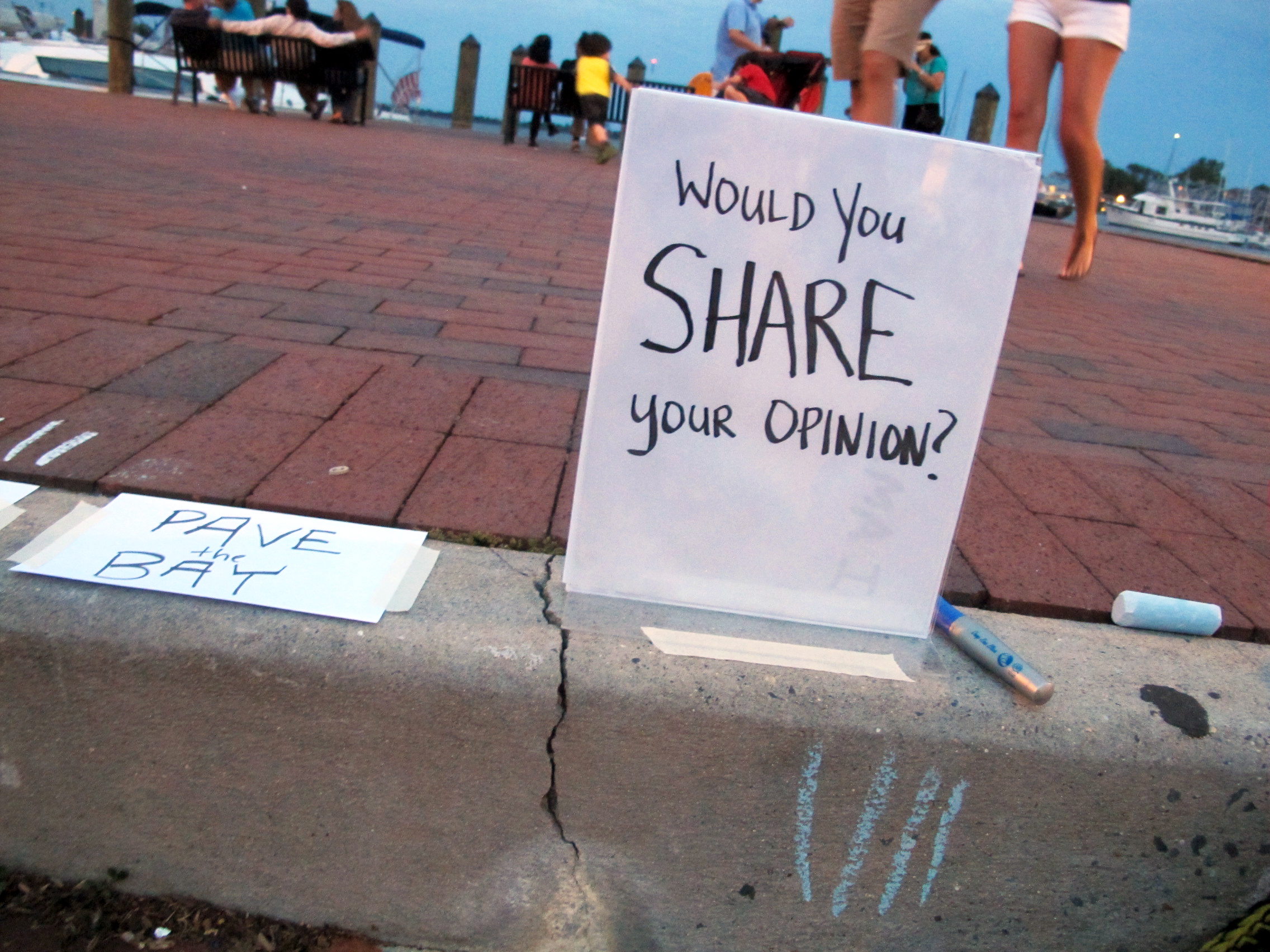
In response to being asked to create “opinion pieces” on environmental advocacy issues this month, I started thinking critically about what my opinions are on advocacy in general and what my approach would be in advocating an issue.  In my last opinion piece posted, I mentioned that I consider asking other’s opinions and listening to others perspectives as my own form of advocating.  I believe engaging people in dialogue is the first and most important step in bringing attention to any issue so I thought I would give it a go. I have been out of practice talking to the public and have not engaged with my actual environment (downtown Annapolis) since I arrived here 5 months ago, so I thought I would do both of these things for the creation of my second opinion piece. The photos below are documentation of the opinion experiment I conducted in the Annapolis Harbor.

My focus topic: Advocacy

My first question: “Can I ask your opinion?”

IMG_4392

My second question: “If you had to convince someone to believe something or do something that you really cared about, what would you do first? Would you listen to their opinion on the topic, or would you share your opinion about why you believe what you believe?”

IMG_4395IMG_4394

My third question: If you were going to advocate for or against one environmental issue what issue do you care about most and want to bring awareness to?

The answers:

Out of the 42 people who I talked with, 29 people said they would LISTEN first than before sharing an opinion when trying to advocate a position and 13 people said they would SHARE first then listen. When I asked “why listen first?” Some people expressed the desire to have the last word in a conversation saying that the last thing heard is what would stick the most. However, the majority of the people I talked to said that finding out where the other person was coming from first would give them a better understanding of how to communicate their own opinion to them.  One person made the comment that first there MUST be even a common fundamental understanding and knowledge around the issue at hand before trying to convince them on any topic one way or the other.  How might someone be convinced to buy organic vegetables if they have spent their entire lives growing up in the inner city and have never set foot on a farm? Or if they have never shopped in a place where they organic vegetables are even offered?

About half of the people who stopped to give their opinions stayed to have a longer conversation with me and shared their own perspectives and concerns on environmental issues.  Below are some ideas and questions that they brought up in conversation and wanted to bring awareness to.

IMG_4384IMG_4386

Here are a few more opinions….

“An affordable solution to environmental problems is mindful awareness”

“How can we reduce our waste/impact on the environment?”

“As the population grows, how can we find a way to decrease air pollution?”

“How do we get everyone on board in supporting environmental policies? A forceful change? Are affordable ways really affordable?”

“How much gas are we really using?”

“Is overpopulation an environmental issue?”

“Take the politics out of decision-making concerning the environment”

“Convert chicken waste into fuel/energy (md specific)”

So you might be asking what did I find in doing this short-lived experiment? What was the result or outcome?  Well,  I am not sure there is a specific outcome, as I was not searching for one.  It definitely was not a scientific experiment of any sort devised to solve any problems.  My goals were to engage people in dialogue about their advocacy methods and to find out specifically what people care about concerning the environment.  And I think I did both just by asking for their opinions.

What about you… what is your opinion?  Would you share your ideas and knowledge first when advocating a position or would you listen to another persons perspective first? And what environmental issues do you feel passionately about to advocate for or against.  Please share your feedback here or on the Living Chapters Facebook page

Photos below are brought to you by my good friend Howard who came out to document my experiment – THANK YOU to everyone who stopped to talk to me for participating.

8/28/13

Just finding this blog today? Read more about the Living Chapters project here.
IMHO

As a part of this month’s chapter challenges, I was asked to write opinion pieces on environmental advocacy issues. When I read this request, I have to admit I cringed.

I am not an op-ed writer, a scientist, or a researcher. I have never studied ecology issues, botany, climate change, sea –level rise, or any topics related to the environment. There are a lot  of people out there advocating about things that they just don’t know that much about and I vowed when starting this blog that I was not going to become one of them.  This blog was created for the purpose of sharing and questioning my personal beliefs rather than advocating or  convincing others to believe or adopt my beliefs.

With that said, it does not mean I do not have opinions to share and that I don’t care about environmental issues. I have very strong opinions about the environment, the work that I do and advocacy in general. I just prefer to share them in dialogues or in informal blog posts rather than in op-ed letters.  More importantly, I believe that anyone who advocates their opinions in public should have a solid knowledge of the topic they’re discussing or equal personal experience to base their ideas on. I admittedly do not possess the knowledge on either topic of “water quality in the Chesapeake Bay” or “natural gas extraction”. So, sorry to say, I will not be fulfilling this particular “Living Chapters” task in the way that it was suggested.

I will however share some of my opinions on advocacy with you. I believe in advocacy. I think it works when there is complete dedication, knowledge and passion behind it.  Advocating is very much like campaigning – using all your efforts and networks to help others understand why you believe what you believe. Often it comes off negative, saying that the person or groups that you are trying to reach, are in the wrong. Can you tell me how you feel when someone says that your heartfelt belief about something is wrong? In my opinion, it is not a good way to try to get anyone to come around to understanding your way of looking at things. (think about the political campaigns in the past 10 years, did any of those candidates reach you with any of their campaign strategies?)

In my opinion, the key to good advocacy work is engaging people with the topics in which you are advocating. Connect with your target audience and engage them with the advocacy issue(s) in a personal way. Find out what your audience cares about and why they care before telling them what they should believe.

Advocate by asking.

So if I had to advocate for anything? I would advocate listening.  I believe listening, followed with dialogue are the two crucial elements in moving toward collective change and problem solving of any kind.

Throughout my entire career, my work has often been confused with direct advocacy work because of the nature of the topics I have focused on and the populations that I have worked with. Topics have included: education and youth, social justice, homelessness, eminent domain, drug addiction, diversity, and the environment. The focus and goal of my work has been to encourage people within the communities I work in to use their own voices and engage with the issues that are important and relevant to them. The key has always been finding out what is important to them.

I find that I am actually pretty good at doing this. It may seem like a weakness to some people, but I believe that one of my biggest talents is my ability to “not advocate” or share my individual voice or strong opinion on issues. In other words… I am a good listener.

This trait alone has enabled me to be welcomed into a variety of organizations, groups, cultures and communities. Being open neutral and welcoming to any and all perspectives when encountering those with different ideas and opinions than my own, has provided me with numerous learning opportunities.

I cannot tell you how many times I have gained trust, built a relationship and gotten further into dialogue with someone by simply asking them to share their opinions before sharing my own. If you are genuinely interested in hearing and learning about someone else they will genuinely express themselves, open up to you and become more willing to listen and engage honestly.

My background in practicing this skill is what most likely landed me my current job at the Maryland Humanities Council. I was hired on to develop one, of their many, dialogue programs Practicing Democracy. This program uses the humanities (film, speakers, literature, and media) to bring Marylanders together for civic dialogue around polarizing community issues. The main challenge in developing this program is to create a place for ALL opinions and voices to be heard and shared in neutral and safe spaces. Another challenge is engaging those diverse voices in the dialogue who have not previously been involved. How do you get people with opposing opinions to really listen to one another?  And if they do come together can they find any common ground?

Well, the jury is still out on both of these questions as we are still experimenting in the ongoing evolution of the program. But in the three years doing these dialogue experiments, I have learned this: The desire for dialogue and thee need for a neutral convener is present. In each of our programs, we have been successful in bringing diverse voices to the table and we have been successful in highlighting and bringing new awareness to the chosen community dialogue topics. How did we do this? We asked for opinions and we asked for personal stories. To succeed in our goals of bringing diverse voices and perspectives together, we needed to leave advocating for or against issues out of the picture entirely. Instead we focused on community engagement, listening to what people cared about and inviting as many people as possible into the discussion no matter what their opinion was.

So yes, I have heard a lot of opinions in my work and have diligently kept my own mouth shut in order to do so. (Although sometimes not an easy task) Through this process I have learned to accept that everyone has their own truth. Some truths are backed by facts or numbers (science) some by personal life or work experience, some are based in faith and some are based in nothing I can understand or agree with. What I do understand though is that if you tell someone their truth is wrong and your truth is right before listening to them, a dialogue is not possible. Without dialogue a compromise is not possible, and without compromise collective change is less likely. And as far as the advocating for the environment – I believe we can all make individual choices and changes. This will help on a small-scale and at a slow pace. But if we want to see monumental progress we need to figure out how to work together and change collectively. And in my humble opinion, if we are going to start working together we have to start listening to one another first.

8/26/13

Just finding this blog today? Read more about the Living Chapters project here.
lost in the supermarket? go fishing!

IMG_4471IMG_4198

It’s only been a few days since I have been tracking my spending habits and I am convinced that almost every decision and purchase that I make has some kind of negative impact on the environment. My mind is spinning with all sorts of questions. Where was the item made? How did it travel here? What is it made of and who made it? What are the different ingredients in it? I thought I was going to have a panic attack standing in the aisles of the local Giant food store peering at all the endless items lining the shelves that I couldn’t buy without racking up the anti-environment points (and guilt for making poor choices). There were very few things for sale that didn’t have wasteful packaging, foreign chemicals, or wasn’t imported from across the world. The only reason I made it out of the store point free is because I gave up and didn’t buy anything.

Who knew shopping would become as complicated a process as hunting down your own food. I started thinking about what I would do if I had to hunt down food sources in this area of the world. What could sustain me? Well besides being surrounded by a ton of fine restaurants, I am surrounded by water after all. Fishing seemed like a much better idea than dumpster diving for fancy food leftovers.

A few weekends ago my friend and fellow liveaboard Suzanne invited me out on her boat for the afternoon. We dropped anchor and made an effort at catching our lunch. I was curious about what kind of fish were living in the waters I have been floating on. I did not fare so well with the fishing but the friends with me caught quite a few – unfortunately not big enough to keep and eat. All of them were croakers (not dead fish – that is their actual name! they make a unique croaking sound when out of water – I guess I would too, if I was hanging from a hook by my mouth)

IMG_4268IMG_4430IMG_4201

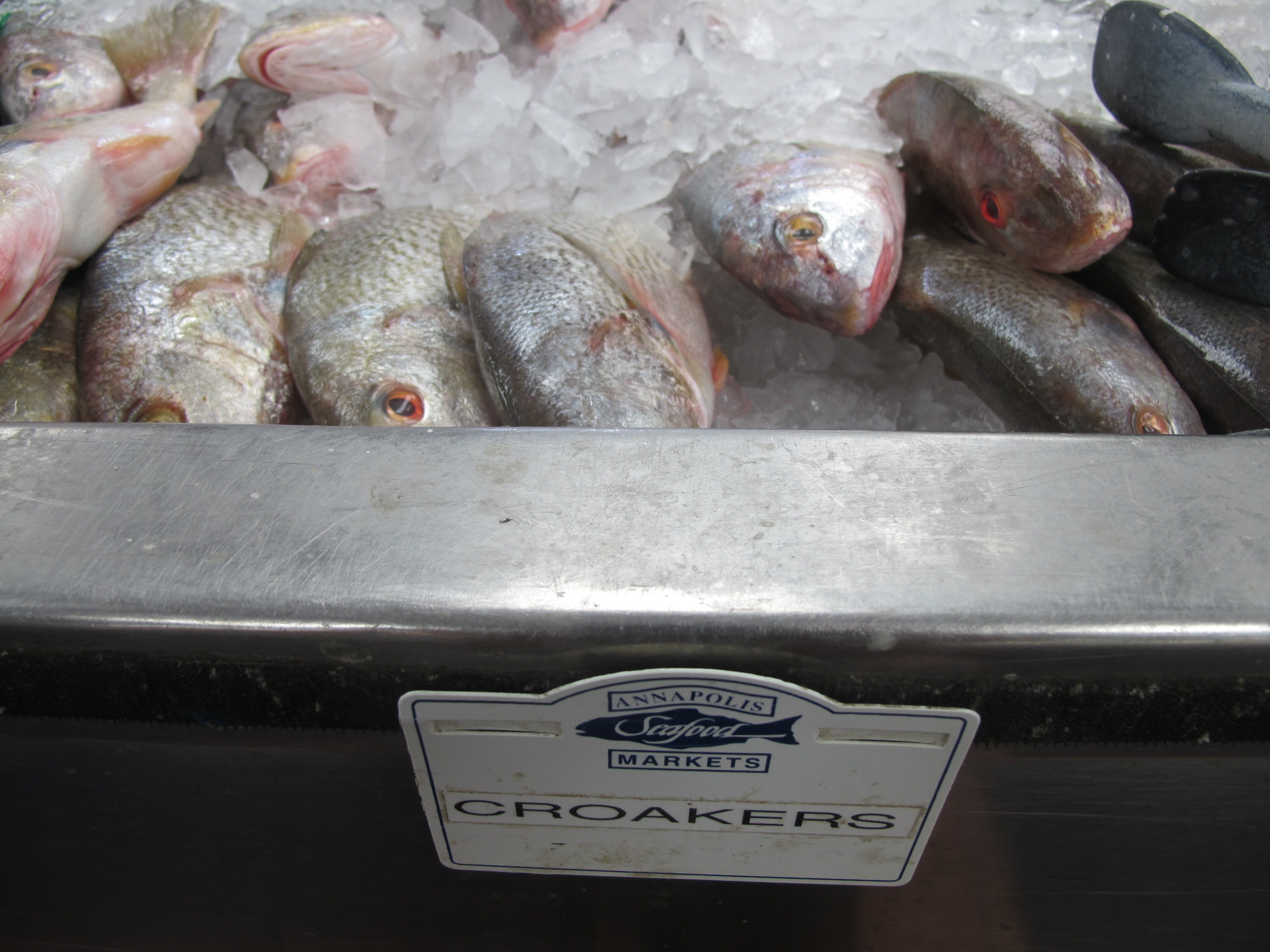
Anyway, the outing inspired me to eat more fish for dinner. Even though I didn’t catch any fish, I did hunt these croakers down at the local Annapolis Seafood Market. The salesmen there are very knowledgeable, friendly, and gave me great cooking and recipe advice as well. I have become an instant fan of this place and have been back a few times, trying a few different kinds of local fish. AND the local fish were less expensive! It was the first frugal find in this eating local adventure.

So besides the Annapolis seafood market, my other favorite green shopping experience has to be my local farmer’s market that is a short walk from the marina I live in. This time of year is amazing for it! Good weather, good food and good people. I found yogurt made with raw milk, fresh fruit, free-range local eggs beautiful veggies and local grass-fed beef burgers. Finally, a place where all of my choices were good choices!

IMG_4338IMG_4314

I came home very happy with my purchases but couldn’t help realizing that I spent double than I would have at the grocery store. Yes I do believe that better food and healthier food is worth the extra money but I also am realistic in saying that if I did make this a habit I would have to sacrifice my spending elsewhere or will just have to start making more $$ weekly. Both doable goals but will take more planning and intention.

So how can I continue to eat well without breaking bank?

Well a few other ideas surfaced when visiting Easton MD, my former neighborhood on the Eastern Shore of MD (where a lot of the local produce comes from in Annapolis). Making this drive across the Bay Bridge racked up my “cap and trade” points for the day, but it was well worth the trip. I was able to visit my favorite fair-trade local coffee shop Rise Up coffee and also catch up with some great friends. I stopped in to see future Living Chapters wild card Doug Sadler and his wife Linda before heading back to Annapolis. Doug and I worked on a story telling/dialogue project (Let’s Be Shore) on land use, agriculture and water quality issues last year when I was living in Easton. He and his wife were interested in hearing how my “environment” chapter was going. While there I got to meet Linda’s sister Jena who works for the organic farm Cottingham Farm in Easton MD. She dropped by bringing bags and bags of beautiful organic vegetables. I was lucky enough to be invited to stay for dinner and got to taste test some of them! YUM. It was really great to talk with Jena about her job at Cottingham Farm. It made me realize that if I felt organic veggies were too expensive to purchase all the time maybe I could get a job or trade my time and volunteer at a farm. Or I could sign up for a CSA (a community supported agriculture share) or share a CSA with some friends. These were all options that could give me better access to this great food and the good practice of growing food organically. Not only did I go home with a full belly of delicious food that night but Doug and Linda sent me home with bags of excess vegetables from their CSA.

Check out Cottingham Farm to learn more about the benefits of organic farming.

Special thank goes out to Suzanne Wheeler who got me out fishing this month! She also writes a great blog about living aboard.  Many thanks also go out to good friends Doug and Linda Sadler for feeding me and generously sending me home with delicious Cottingham Farm vegetables.

IMG_4256IMG_4468

My latest shopping soundtrack:

8/24/13

Just finding this blog today? Read more about the Living Chapters project here.

put your money where your mouth is

IMG_4413IMG_4412

So Dave – You hit on the real point system that we all tally daily $$$ ! What DO we spend our money on? And how does the way in which we spend our dollar really affect our environment (far more than any of my showering habits ever could?)

Maybe we all have been a bit too cerebral when examining the environmental challenge this month. Yes, I do believe that making personal changes in our daily lives and habits can make a huge positive impact on our immediate environment – but how are we going to get the majority of people to follow suit, when even I, as a middle class single person, have a hard time keeping up with all the right choices.  Let’s get real for a moment… what is the one thing that the large majority of people pay the most attention to when faced with making a purchasing or personal life decision?

I think it often comes down to two things:

1. Is this something that I really want or care about?

And of course

2. Can I afford it?

I believe that this is the reality that most people, (including myself) consider first. We look into our wallets, before examining our personal belief systems about how we might be impacting positively or negatively on the environment when using our dollar. I am not judging anyone for doing this – I do it myself and understand fully why I choose to be frugal first.

I do wish however that this could be different. Are there ways of getting around financial constraints when making our purchasing decisions? Are there ways of making the enviro-friendly choice, not only more appealing and desirable to the general public, but also more affordable and accessible?  These are challenges we will all need to face when trying to advocate or adopt major societal shifts in approaching better environmental practices. Or they simply will not work.

Yes! Doing the small things that you can do does help! Keep doing it! But can we think bigger and figure out a way that more of us can also participate in this effort? Wouldn’t it be great if we could collectively get past the overlying question of “Can we afford it?” and instead start examining the questions of “How can we make healthy and positive choices affordable?” and “How will these choices better my life as an individual?”

How we get there I am not sure. But it is possible.

Sorry Dave, am I getting too cerebral again? I digress. In Dave’s wildcard challenge – he specifically asks me to think about how I am spending my dollar. The task is to really think about what I am purchasing and its impact on the environment positive or negative. Well believe me – I am thinking about it! It’s like a labyrinth that I’ve wandered into and I am afraid of never finding my way out. However, instead of getting lost in the constant confusion of the Cap and Trade point system, adding and subtracting everything I purchase as well as every mile I drive. I will simply make a focused effort to record and reflect upon what I am purchasing. Am I capable of putting my money where my mouth is?

If you have ideas or examples of food, products or services that you feel are both good for the environment and affordable please do share them with me! I will need all the help I can get with this task!

8/20/13

Just finding this blog today? Read more about the Living Chapters project here.

August: Wild Card

IMG_3093IMG_3104

For those of you who aren’t familiar with the Roles and the Rules for this project, the Wild Card adds one new element to the finished written chapter by playing their one and only card for the month. This “card” is really a suggestion or a new task that will shift or re-energize the chapter.  It may add an element of risk or an element of reflection and reverence. The wild card action must be played at the mid way mark of the month and will be taken on by the protagonist.  This new element may elevate an activity already written or diversify the challenge by changing the frequency or specifying a detail.  The Wild Card cannot eliminate pieces of the written chapter or negate any part of the written chapter. The Wild Card also should also take into consideration the chapter theme and the writers’ already composed directives when making their suggestion.

____________________________________________________________________

Man, the first thing I’m thinking as I read through all of the chapters is, what a cerebral ensemble  Beth has inserted me into…grand ideas!  Awesome start!! Then I thought well … It’s Beth!  …If  I’m digging the content…Does that make me cerebral too…oh snap!! Anyway, I don’t think it does… But gee wiz…it was difficult to think of a challenge that would be on par with the “Superfriends”.  I like Andy’s chapter… Especially Part II…”The Cap and Trade game” I’d like to add a category please  …..MONEY!

Now we all know that Beth is incredibly frugal.. So I’m not sure
how much this category will yield.  But since Living Chapters has evoked a new level of transparency in Beth.. I’m challenging her.. to be more thoughtful and apply a bit more investigation into the who,what and where surrounding her expenditures… If possible!!

+5 points every time you make a purchase that adversely impacts the environment

-3 points if you make an expenditure that has a positive impact on the environment

… And yes, you can be deliberate.  Heal the world man, heal the world!

That’s it in a nut shell!  Start spending your millions wisely Barbush!

___________________________________________________________________

CAP and TRADE UPDATE!

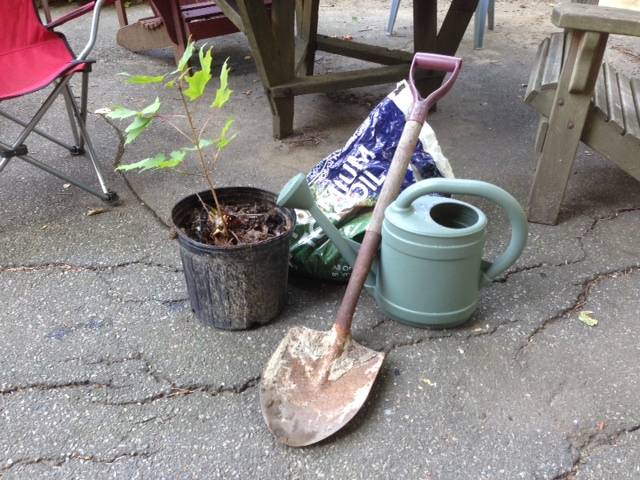
By the end of the first week playing the Cap and Trade game, Writer Andy Cook came in over the CAP and our protagonist came in under.  Beth traded some of her points with Andy in exchange for Andy planting a tree and reading up on some environmental issues. Here is the evidence of Andy’s “Trade Tasks” being accomplished:

AC instrumentsAC - watering AC planting AC - book

8/19/13

Just finding this blog today? Read more about the Living Chapters project here.